
MoovSwim’s Philosophy on Swim Teaching: A Structured, Child-Centred Approach
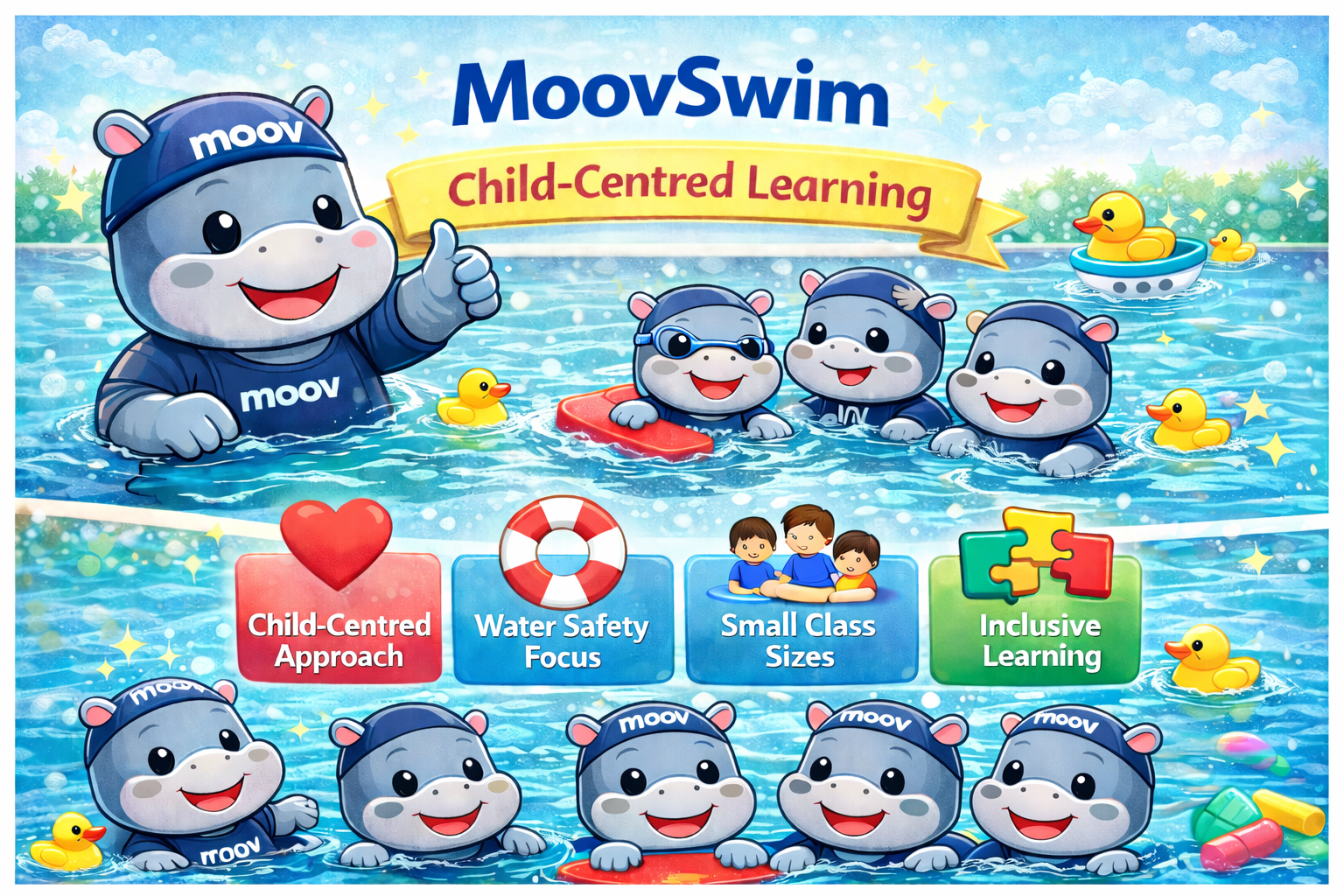
At MoovSwim, the teaching philosophy is grounded in systematic development of water competence, confidence, and safety for children of all ages — from infants to those with special needs. This philosophy is articulated clearly on the MoovSwim website and emphasises a progressive, evidence-informed framework tailored to each child’s developmental readiness.
1. Child-Centred Learning and Progression
Central to MoovSwim’s philosophy is the belief that every child is capable of learning to swim given appropriate support and time. Instruction is not rigidly prescriptive; instead, it is paced according to each child’s readiness and comfort level in the water. The programme prioritises water familiarisation and enjoyment in the early stages, using play-based activities, songs, and interactive tasks to make learning meaningful and intrinsically motivating.
This approach reduces anxiety and builds positive associations with water, fostering both confidence and willingness to engage — foundational elements for later skill acquisition.
2. Focus on Water Safety and Competence
Water safety is a core objective of MoovSwim’s curriculum. In Singapore, unintentional drowning is a significant cause of pediatric injury and mortality, making aquatic safety education imperative.
Rather than jumping immediately to advanced swim techniques, MoovSwim focuses on:
Developing an understanding of water and body positioning
Encouraging independent movement and floating
Instiling safe responses to unexpected immersion
This establishes a solid foundation of competence — a critical step before introducing more formal swimming strokes.
3. Role of Caregivers as Active Participants
In the baby and toddler stages, parents or caregivers are integral to the learning process. The philosophy emphasises education and empowerment of caregivers, who are coached on appropriate support techniques, equipment use, and risk awareness. This ensures that learning continues beyond structured lessons and reinforces water safety behaviours at home and in daily life.
4. Instructional Ratios that Support Individual Needs
MoovSwim maintains low teacher-to-student ratios to maximise individual attention. For toddlers and older children, smaller group settings enable instructors to observe and address each child’s unique needs while maintaining strong supervision — an essential aspect of safe, effective aquatic teaching.
5. Practical Teaching Methods Over Technical Rigor
Although informed by evidence and coaching experience, the teaching at MoovSwim is practical rather than technical. Recognising that children do not learn like elite swimmers, the programme uses sensory-rich methods — tactile guidance, visual cues, and sound-based activities — to help children internalise movement patterns and build foundational motor skills.
This pragmatic pedagogy supports gradual skill progression, making the transition to more formal swimming techniques smoother and more sustainable.
6. Inclusion and Personalisation for Special Needs Learners
MoovSwim extends its philosophy to support children with special needs through personalised lesson plans and adaptations. Lessons for these learners are conducted in a reassuring, calm environment, using games and sensory-based activities to promote engagement, water awareness, and social participation.
This inclusive approach recognises the diverse ways in which children learn and interact with water, ensuring that the benefits of aquatic competence are accessible to all.
Conclusion
MoovSwim’s teaching philosophy integrates developmental science, safety imperatives, and child psychology into a comprehensive framework for aquatic education. It moves beyond traditional swimming instruction by emphasising confidence first, technique later, and by positioning caregivers as key partners in the learning journey. The result is a methodical, child-centred system that supports both skill acquisition and lifelong comfort in the water.
